Showing posts with label traditional liturgy. Show all posts

Wednesday, December 6, 2017

Reflecting on the Traditions of the Universal Catholic Church

Last Sunday, I had the opportunity to visit an Eritrean Catholic community. I say community because there currently are no parishes belonging to the Eritrean Catholic Church in North America. The Eritrean Catholic community is very small in this country, and in this case, the local community meets once a month for Mass at a Latin Rite church. To get a brief overview of the newest sui iuris Church, take a look at my earlier essay here.

Also, I was able to participate in Vesperal Divine Liturgy for the Vigil of St. Nicholas at a Ruthenian Catholic parish just yesterday. With St. Nicholas of Myra being my patron saint and all, I did not want to miss this opportunity. Anyone familiar with this blog knows that I don't hide my love for the Eastern Catholic Churches, particularly the Byzantine Rite. But I have to say, both of these recent experiences were absolutely beautiful. And in reflecting on their beauty, their magnificent praise of our Lord, I started thinking about my own rite, the Latin Rite, and how banality has become the status quo. I found myself asking a question that I'm sure many before me have also asked: what happened?

Now I won't give a full treatment here of my experience at the Eritrean Catholic Divine Liturgy, as I should have something up on that soon elsewhere, but I at least want to express how lovely my experience was there. As can be seen in the above picture, a lot of incense was used during the Divine Liturgy. A deacon and server assisted the priest, with the deacon constantly ringing bells at various points, such as when the Gospel was processed around the altar. This reminded me of the procession that the Byzantines do. The priest, while in the sanctuary, also blessed the four cardinal points with incense before reading the Gospel. The priest and deacon also came forward out of the sanctuary to read the Gospel, just like in the Byzantine Rite, although it was the priest that read and the deacon that held the lectionary. as the Divine Liturgy continued, I noticed that what was happening here, in the Alexandrian (or Ge'ez Rite) Divine Liturgy, was more similar to what the Byzantines do than what the Latins do. And both of those rites shared many similarities with what takes place in the East Syrian Rite, specifically the Syro-Malabar Catholic Church from what I remember.
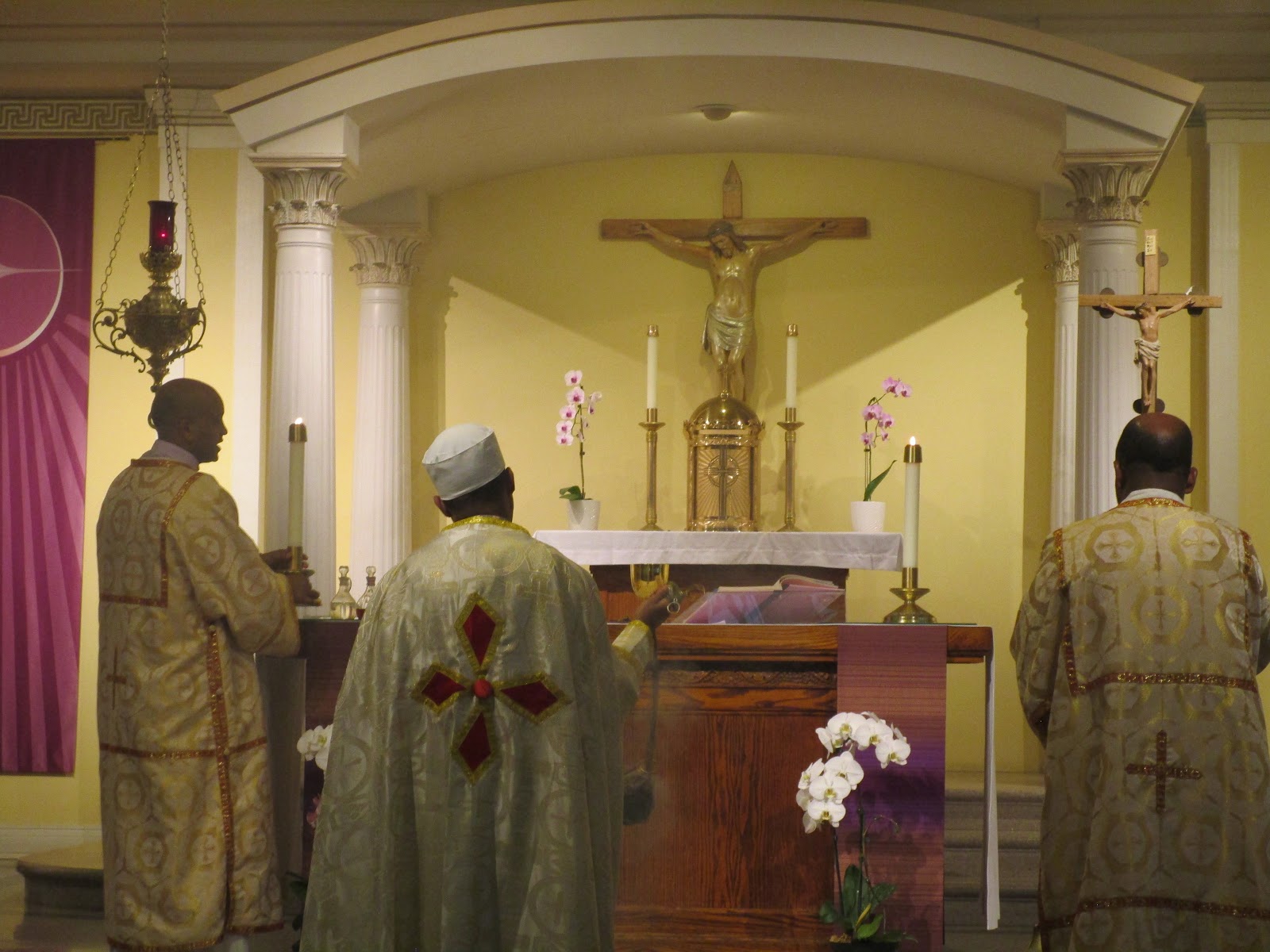
Divine Liturgy with the Holy Family Eritrean Catholic Community

Saturday, September 2, 2017

What Exactly Is "Active Participation" and "Noble Simplicity" in the Context of Holy Mass?

Kind of piggybacking of of Pope Francis' comments (which really were a non-story, and were not controversial at all), I got into a bit of a discussion on elements of liturgical worship. The usual charges against traditional liturgical worship were bandied about, unfortunately. Charges that the extraordinary Form of the Mass didn't reflect "noble simplicity" or had too many "useless repetitions". Below is the conversation that I and several others had on the subject.

There are some good citations from same great essays that I do not want to be lost, so I'll post links to everything here as well for posterity's sake. My words will be in blue, with the others' in various, different colors. The whole conversation "began" when one person found it inaccurate to say that Latin encourages a camaraderie among the faithful.

Harry: The common Latin language encourages a bond of brotherhood between Catholics of all countries, rich and poor, far and wide. 

The problem is that perhaps memory of the pre-reform period has to pass before we can change attitudes to Latin. People will then come to see it not as a mysterious and alien language that shuts them out of the litugy, but as their liturgical language in which is expressed their universality of rite, their brotherhood with their fellows Catholics and not least, their intimacy with Almighty God, for whose worship this language is set aside in their lives. 

The argument that people won't understand the words of the Sanctus and Gloria in Latin when they say them every single week, and read from a Missal with both languages side by side, is just nonsensical. 

We have failed Vatican II when it comes to Latin. It should play a greater role in the reformed liturgy, where it can do all kinds of good without impeding active and conscious participation, if it is employed proportionally and only to the unchanging parts of the Mass. 

''Nevertheless steps should be taken so that the faithful may also be able to say or to sing together in Latin those parts of the Ordinary of the Mass which pertain to them.''

Completion of the liturgical reform of Vatican II as referred to by the Holy Father this week, must involve this. Otherwise we have only a 'partial revelation'.

Tom: The only common bond was that the laity were equally disconnected with the Mass. The Mass prayers were said by the priest and altar boys and the people sat and stared. 

You mentioned Hong Kong, and it reminds me of how the Vatican once held that nothing of Chinese culture could be brought into the celebration of the Mass.

Thankfully, that was lifted and Chinese can and do bring their culture into parts of the Mass without changing the consecration itself. 

Sunday, August 27, 2017

On Pope Francis' Address on the Irreversible Reforms of the Second Vatican Council

This recent address by the Pope has been making the rounds all over the web in the last few days. In this address to a group of Italian liturgists, His Holiness said this:
"...we can affirm with certainty and magisterial authority that the liturgical reform is irreversible.... 
"And today there is still work in this direction [in the liturgical education of pastors and faithful], in particular rediscovering the reasons for the decisions made with the liturgical reform, overcoming unfounded and superficial readings, partial revelations, and practices that disfigure it."
I think this is really a non-story, and people on both sides are going to twist it in their own way. One side will think Pope Francis is attacking them (I don't think he's attacking anyone) and the other side will think that Pope Francis is supporting a false "spirit of Vatican II" that was extremely popular in the 1970's and 80's.
Pope Francis

Friday, June 9, 2017

Priest Resigns After Implementing Traditional Changes: Why Is "Restoration" a Negative Thing?

A couple of days ago, a local news story out of Charlotte broke regarding a Catholic priest. Apparently, after being pastor at a small parish for nearly three years, Fr. Christopher Riehl resigned after several of his parishioners expressed their displeasure with his more traditional directives that were implemented. A rift had risen in the parish, with those who were complaining about his leadership splintering off to hear Mass at a dentist's office in "exile", as some described it. From The Charlotte Observer:
The pastor of a Catholic church in the N.C. mountains whose conservative leadership style split the congregation and drew national media attention has resigned. 
In a Facebook post, the Rev. Christopher Riehl of St. John the Evangelist parish in Waynesville wrote that he was “worn out or burned out” and for his own well-being needed to take a sabbatical. 
He did not mention the rancor at the parish, where he’s been pastor for nearly three years, or the petition by more than 100 members to have him removed. It was sent to Bishop Peter Jugis, who leads the 46-county Catholic Diocese of Charlotte.
The National Catholic Reporter published a January article on the clash between Riehl and many parishioners in the church of about 250 families. Some of those members have left St. John’s. 
The article cast the divide as one of a new pastor who preferred traditionalist approaches to the liturgy and church governance versus parishioners who cherished what had been St. John’s post-Vatican II style of a greater role for the laity and more modern worship and music. 
Vatican II refers to the Second Vatican Council of the early- to mid-1960s, when the Roman Catholic Church, for example, permitted the use of local languages for a Mass that had traditionally been celebrated all over the world in Latin. 
According to the National Catholic Reporter article, Riehl threw out popular hymns and replaced them with the ancient Gregorian chant. When the music director was relieved of her duties, the article said, most of the choir resigned. 
A group calling itself Appalachian Catholics in the Smoky Mountain Region said in a statement earlier this year that Riehl and some other conservative priests assigned by Jugis to small parishes in the mountains “seem to be more intent on taking the church back to pre-Vatican ll days rather than minister to the people. They seem to be steeped in doctrine and theology, but are unwilling to participate in ecumenical activities, and are lacking in compassion, love and mercy. They are doing the job of the theologian, but not the job of the pastor. This is directly opposed to what Pope Francis and Vatican II are teaching us.”...
In his June 4 Facebook post to members of his “parish family,” Riehl wrote that his leaving was not prompted by anything other than his own need to take some time away from parish ministry. 
“It is with a heavy heart that I must inform you that I have decided, of my own free will and my own instigation, to resign my position here at St. John’s,” he wrote. “I have found that I am worn out or burned out and for my own well being need to take a sabbatical. There was no incident or event, just a feeling that I need some time away from full parish ministry. I have absolutely no questions or doubts about my vocation to the Priesthood of Christ.”
A very sad state of affairs, indeed. NCR (more aptly called the Fishwrap or National Catholic Distorter, by others), also ripped Fr. Riehl over a year and a half ago in an earlier article, which I will quote more below. One commenter on the recent developments in this story said the following:
This new trend is disturbing to me - out with faith, hope and love ... in with appearances of reverence. I am glad these parishioners fought back against this movement of clerical snobbery. I get the sense that some of these younger priests just want to say Mass in what they perceive to be a reverent, or legal, style, without parishioners. It seems like they are removing the communion part of the faith. I hope priests like this can see that their approach is deeply flawed.  
I am now starting to understand why our Holy Father talks so much about clericalism, rigidity and legalism in the Church.
The only trend that is disturbing is the trend of disobedience and the trend that wants to see the Latin Rite purged of all it's legitimate traditions. This whole episode leads me to compare and contrast the Latin and Byzantine Rites a bit. But more on that in a bit.
St. Gregory the Great- Jusepe de Ribera

Wednesday, May 31, 2017

More Dioceses Restoring the Order of the Sacraments of Initiation

I was confused a few days ago when I kept seeing people posting a two year old news story on how the Archbishop of Denver was restoring the traditional order of the Sacraments of initiation. That is, the age for Confirmation was being lowered so that it would be received before First Holy Communion in the Latin Rite of the Church. I later found out that the reason this is in the news again is because the changes were being staggered, and are finally taking full effect this year. All children in the third grade will receive Confirmation and First Holy Communion at the same Mass. I applaud this decision, and I sincerely hope to see it happen in my own diocese at some point... preferably before my own children reach the second or third grade. A little background on all this "restoring the order business, though.
The Seven Sacraments: Confirmation- Nicolas Poussin


Friday, May 26, 2017

New Catholic Stand Post on the Beauty of the Latin Rite

My latest, original essay is up on Catholic Stand. I've blogged here before that I often spend a lot of time worshipping with Byzantine Catholics, and I've noticed something during that time. At the same moment those in the Byzantine Rite were exhorted to maintain their beautiful and legitimate liturgical traditions, those in the Latin Rite began to discard their venerable liturgical traditions for an, oftentimes, hokey and bland minimalism, which made grandeur and feelings of awe in the Sacrifice of the Mass something to be purged and/or avoided. How can Roman Catholics reclaim this beauty and reverence that Byzantine Catholics have maintained for centuries? Here's a snippet of my thoughts, which you can finish reading at the link below:
While I myself am a Latin Rite Catholic, my maternal grandmother’s side of the family belongs to the Byzantine Rite, specifically the Ukrainian Greek Catholic Church (UGCC). I’ve always felt that I’ve grown up with the best of both worlds. But now, with a Byzantine Rite parish so close to my home, I find myself drawn to this form of worship more and more. This is a rite in the Catholic Church which has not lost its traditions, as we have painfully seen in many Latin Rite parishes throughout the world. 
It can be rightly argued that we as Latin Catholics have an identity crisis; the Byzantines do not. On the contrary, many Latinizations that have been acquired in the last several generations are disappearing in many Byzantine parishes. Yet, despite all this, I wish to stick with the Latin Rite. I want to help, in whatever small way I can, to regain our Latin traditions as the Byzantines have.


Read the rest HERE.

Thursday, March 2, 2017

The Penitential Nature of the Great Canon of St. Andrew

Today, I was able to experience something different compared to what I have encountered during my Lenten journeys over my life. Many Latin Catholics probably aren't too familiar with the Great Canon of St. Andrew of Crete. If you want to be immersed in the beauty of the Byzantine liturgical tradition, you should look no further than the singing of these hymns during the canon. The canon was written by the great hymnographer, St. Andrew, bishop of Crete, in the seventh century. It is the longest canon ever created, with 250 hymns when sung in its entirety.

During the first week of Great Lent (also known as Pure Week), the Canon is divided into four parts, Monday through Thursday. On the fifth Thursday of Lent, the canon is sung in its entirety, lasting over three hours. I went on a Thursday night, and while it was beautiful and intimate, it was definitely a work out, and was not what I was expecting. Following the opening incensation of the church, we got a little pep talk by the priest. He told us if we felt tired, to take a break. He advised us to get water if our voice cracked, since we would be doing a lot of singing. But why would he warn us about getting tired? Because the entire service included over 100 full body prostrations... and that was just for Thursday's portion.
St. Andrew of Crete and St. Mary of Egypt

Wednesday, March 1, 2017

What Modern Day Iconoclasm Has Done to Catholic Parishes

This past Sunday, my wife and I had to attend Mass out of town at a different church that was outside of our diocese. That always pains me a bit because our pastor at our home parish is pretty cool and knowledgeable, not to mention there are other nearby parishes which are solid in their own right.

Now I've been to some ugly Catholic churches before, but this one stood out in its preeminent blandness. After I walked in, I remembered being there for a great uncle's funeral before. But this time, I was able to see how this church was basically a hold over from the proponents of iconoclasm, which had been condemned as heretical over a millennium ago. Why was I seeing such a naked church in the 21st century?

Of course, the church was built 30 years ago, so the somewhat clandestine revival of iconoclasm was obviously a thing in the years and decades following the Second Vatican Council. But let's not forget that the Council never called for such ugly and white washed houses of worship to be made.
Altar of St. Joseph at Basilique Notre-Dame de Bonne Nouvelle de Rennes

Tuesday, December 13, 2016

Is Praying Towards the East During Mass "Rubbish"?

On the ever hilarious Catholic Memes page, a new meme was posted regarding the ad orientem kerfuffle that's been going on since the Second Vatican Council... but more recently since Prefect of the Congregation for Divine Worship and the Discipline of the Sacraments, Cardinal Sarah, addressed a liturgical conference earlier this summer in London. Now before I go on, I get the joke that is trying to be made in this meme, pictured below with everyone's favorite green Muppet, Kermit. But not everyone does when first reading this meme. Apparently, there have been a few bishops in the US and UK who have told their priests that they should not (note, not barred) expect to perform the Ordinary Form of the Mass ad orientem, or with both priest and congregation facing the altar in prayer.

I personally do not like this meme as the meaning can be misconstrued, especially for someone who has no foreknowledge of what has been going on the past few months. At first glance, it looks like the meme is advocating that priests and laity should disobey their bishops. Do I think it's funny? Yes, but the way it was executed is pretty bad. I think there was a better way to make the joke, and to make the meme not appear as if it were giving approval to someone disobeying their bishop.

That being said, there was of course, a fiery discussion ongoing in the comments section, and one caught my eye. hence, the title of this blog post. One Latin Catholic woman (in red) said the following, with another Latin Catholic man (in green) responding to her. Many of the things she says are nonsensical, especially her assertion that since "God is in our midst", there's no reason to face the altar in a common orientation. If that were the case, then it shouldn't be a problem if, when we're about to receive Communion and the priest holds up the Eucharist saying "the Body of Christ", we turn around facing the people behind us and say "Amen"! But of course that would be a problem! Not to mention God is among us in a way that is different in the Eucharist, he is substantially there before us. Christains do not believe in a pantheistic god, that God is literally everything. God is Being itself. He is locally, and substantially present in the Eucharist, reserved in all the tabernacles throughout the world. The conversation is below. My words will be in blue:

Sunday, November 20, 2016

The Tridentine Latin Mass From a Young Person's View

There seems to be a lot of sparks flying around the Church in recent days, and it's sad to see so many divisions coming out between the Pope, bishops, cardinals, priests, and lay people. There is so much on my mind regarding these things, but the first I'd like to address are some comments made by the Holy Father about a week ago regarding the Extraordinary Form (EF) of the Latin Rite. A book was recently published featuring a collection of homilies and speeches given by Pope Francis when he was still archbishop of Buenos Aries. The Pope made a few remarks regarding those that have somewhat of an affinity for the Latin mass, but I'll focus on just one of those comments that was publicized. I give our Holy Father the benefit of the doubt always, and I feel that in his other comments he was talking about a specific group of people in mind, while nebulous, I assume refers to groups such as the SSPX as well as sedevacantists. The point I'd like to address is as follows:
"Other than those who are sincere and ask for this possibility out of habit or devotion, can this desire express something else? Are there dangers?" 
[Pope:] "I ask myself about this. For example, I always try to understand what is behind those individuals who are too young to have lived the pre-Conciliar liturgy, and who want it nonetheless.
I do wonder if the Holy Father ever got an answer to his question. Groups like Juventutem give a pretty good answer as to why young people have been drawn to the EF. I would like to answer his question in my own words though, especially so that people can see that many who "want" the EF of the Latin Rite in their spiritual lives, do not do so out of a misguided rigidity. Obviously, I am one of those young people that lived long after the Second Vatican Council. I'm in my late-20's now, and I only experienced my first EF Mass in my mid-20's when I was still dating my wife. I remember that first Mass. It was at St. John Cantius in Chicago. We both wanted to check it out, so we could learn a bit more about the traditions of our faith. I came in without a missal, didn't know where to grab one, and was lost for much of the Mass. I remember thinking to myself, despite liking the Gregorian chant, "Well, I'll probably never do this again. How can I possibly learn what's going on?"

Tuesday, August 23, 2016

New Article on the Mass Said Ad Oriemtem on Catholic365

Forgot to post this, but I recently turned one of my dialogue blog posts into an essay format, which is now posted at Catholic365.com. Be sure to check it out, and you can find a snippet of the article below:

Friday, August 5, 2016

More on Facing Ad Orientem

So the dust has settled somewhat following Cardinal Sarah's controversial, but really not-so controversial, comments on the Sacrifice of the Mass being celebrated ad oreintum, that is towards liturgical East facing the altar. There was an interesting thread I had been following over at Catholic Answers, and after enough time had passed, I finally decided to jump in after reading some confusing statements from an European priest and another person.

The discussion was in regards to Cardinal Nichols comments on what cardinal Sarah had said. In short, he formally deterred his priests from saying the Ordinary Form (OF) of the Mass ad orientem. This of course, is something that the Church has already spoken about, and proved that the Church does not necessarily favor one (ad orientem or versus populum) over the other. In the thread I replied to, the charge was made that the Church now favors worship facing the people. This of course couldn't be further from the truth, as seen in the link above. My reply follows after the jump, and I'll probably make this into an article at some point, but for now, I'll just post my direct comments on the issue, which is alos supported by various quotes from Doctors of the Church who talk about the use of ad orientem during the Holy Mass is actually an apostolic tradition.

Friday, July 15, 2016

The So-Called "Altar Wars": Is All the Arguing Worth It?

So if you haven't heard, Cardinal Robert Sarah, Prefect of the Congregation for Divine Worship and the Discipline of the Sacraments, had some not-so startling things to say. He made a suggestion that pastors and bishops of the Latin Rite worldwide consider turning East towards the altar (ad orientum) in the Ordinary Form of the Mass. He said in part:
"I believe that it is very important that we return as soon as possible to a common orientation, of priests and the faithful turned together in the same direction—Eastwards or at least towards the apse—to the Lord who comes, in those parts of the liturgical rites when we are addressing God. This practice is permitted by current liturgical legislation. It is perfectly legitimate in the modern rite. Indeed, I think it is a very important step in ensuring that in our celebrations the Lord is truly at the centre."
There truly is nothing controversial in this, as facing towards the East has always been permitted since Vatican II, although it's something that isn't commonly seen in the Ordinary Form since the 1960's. However, many people have made a big deal about it, and it caused such a stir (apparently) that a clarification had to come out that the good Cardinal did not issue a mandate to be implemented this Advent, but merely a suggestion. I, and many others, thought that this being a suggestion was apparent. It seems to me that with all this correction and clarification going on, we've been seeing a lot more recently (and not just on this issue) the words of Our Lady at Akita in 1973 coming to pass: "The work of the devil will infiltrate even into the Church in such a way that one will see cardinals opposing cardinals, bishops against bishops." We should never see cardinals opposing cardinals, as it's scandalous not only for Catholics, but other Christians and non-Christians as well... and yet here we are.
Robert Cardinal Sarah

Sunday, May 29, 2016

Part II of Intro to Eastern Catholic Churches... Plus a Preview of Part III: The Alexandrian Rite

The second part of my essay series on the Eastern Catholic Churches is live over at Catholic365.com. This specific essay deals with the Armenian Rite which houses the Armenian Catholic Church. If you missed the first part of the series, which briefly went over the many different sui iuris Churches and rites, you can check that out HERE.

The third part of this series should be going live this coming week and will be on the Alexandrian Rite. This is a liturgical tradition many in the West might not have too much interaction with, outside of the occasional Coptic Orthodox Church, which dwarfs the Coptic Catholic Church in size. Here's a preview of that essay for you to check out now, and I'll post the link to the full article once it's live this coming week.

Sunday, March 27, 2016

Experiencing the Double Feast of Good Friday and the Annunciation

I post this entry on Easter, and I wish a Happy Easter to all! I have to say this has been one of the most enriching Holy Weeks in my memory. I was able to receive the Eucharist multiple times over the past 8 days, and was able to experience the great traditions of the Church both East and West, as I attended the Extraordinary Form of the Mass on Easter Sunday, and the Divine Liturgy at the local Ruthenian Catholic church for Good Friday and there again for Jerusalem matins on Saturday morning. But Id like to focus on the wonderful things I saw celebrated through the Byzantine Rite on the double feast of Holy and Great Friday (as the Byzantines call it) and the Annunciation.

It was fitting that the church I went to on Friday was named "Annunciation", and the parish went all out, with the pastor making a new icon of Christ entombed on a shroud to be venerated for the faithful, as this double feast will never happen again in our lifetimes. the next time Good Friday and the Annunciation will coincide will be in the year 2157! So this surely was a once in a lifetime experience, and it was sure worth it going out to be a part of it. Many reflections were posted throughout the web, detailing the seeming contradiction between celebrating the conception and death of our Lord, but this paradox really makes sense when you think about it, and it's a powerful reminder of how much Christ loves us; that by divine condescension He became man in a Virgin's womb, and then in the ultimate act of love died for us so as to redeem us. This juxtaposition was seen clearly at Divine Liturgy, and here's how it all went down.
Annunciation of the Theotokos- Serbian Icon

Saturday, January 30, 2016

Reclaiming Our Faith and Our Tradition

This has been bugging me for a while, and I guess now I finally feel the need to verbalize it (or at least type it, I suppose). Does anyone else grow tired of the fact that Roman Catholics (that is, Catholics of the Latin Rite) have been out of touch with their particular traditions, devotions and overall demeanor and expression of their faith? Now my current parish is pretty good for the most part, except for instances when a visiting priest who is not our pastor comes in, giving eyebrow raising homilies. However, I feel that everything is watered down in a lot of Latin parishes, especially here in the United States where I reside.

Few parishes make use of incense. Our priests often do not have the beautiful vestments that our Latin Rite permits, or, show a disregard for (or were never taught in the first place) the correct vestments to be used, i.e. wearing blue for Marian feasts is not permitted in the Latin Rite. Often, liturgies are truncated because it "takes to much time" to do all the extra things that make the Roman liturgy beautiful. Too often, devotions such as benediction or adoration are pushed into the background, and novenas which used to be said throughout churches (including my parish were I grew up at) are now unfortunately forgotten by the laity. Instead, we now have a decent chance, in the US, of walking into a Roman Catholic church and finding that the liturgy is quasi-Protestant where the Propers for Mass aren't used, extraordinary ministers of the Eucharist are plentiful, the dress of the laity is not becoming of a wedding banquet (which the Mass actually is; the Bridegroom has come to consummate His covenant [His death on the Cross] with His Bride, the Church), and the homilies are banal and often forget to mention, expound, or even acknowledge true Catholic teaching on a myriad of subjects. As the 20th century theologian Dietrich von Hildebrand said, "The new liturgy [can] threaten to frustrate the confrontation with Christ, for it discourages reverence in the face of mystery, precludes awe, and all but extinguishes a sense of sacredness."

Divine Liturgy celebrated at a Ukrainian Catholic Church