Wednesday, December 6, 2017

Reflecting on the Traditions of the Universal Catholic Church

Last Sunday, I had the opportunity to visit an Eritrean Catholic community. I say community because there currently are no parishes belonging to the Eritrean Catholic Church in North America. The Eritrean Catholic community is very small in this country, and in this case, the local community meets once a month for Mass at a Latin Rite church. To get a brief overview of the newest sui iuris Church, take a look at my earlier essay here.

Also, I was able to participate in Vesperal Divine Liturgy for the Vigil of St. Nicholas at a Ruthenian Catholic parish just yesterday. With St. Nicholas of Myra being my patron saint and all, I did not want to miss this opportunity. Anyone familiar with this blog knows that I don't hide my love for the Eastern Catholic Churches, particularly the Byzantine Rite. But I have to say, both of these recent experiences were absolutely beautiful. And in reflecting on their beauty, their magnificent praise of our Lord, I started thinking about my own rite, the Latin Rite, and how banality has become the status quo. I found myself asking a question that I'm sure many before me have also asked: what happened?

Now I won't give a full treatment here of my experience at the Eritrean Catholic Divine Liturgy, as I should have something up on that soon elsewhere, but I at least want to express how lovely my experience was there. As can be seen in the above picture, a lot of incense was used during the Divine Liturgy. A deacon and server assisted the priest, with the deacon constantly ringing bells at various points, such as when the Gospel was processed around the altar. This reminded me of the procession that the Byzantines do. The priest, while in the sanctuary, also blessed the four cardinal points with incense before reading the Gospel. The priest and deacon also came forward out of the sanctuary to read the Gospel, just like in the Byzantine Rite, although it was the priest that read and the deacon that held the lectionary. as the Divine Liturgy continued, I noticed that what was happening here, in the Alexandrian (or Ge'ez Rite) Divine Liturgy, was more similar to what the Byzantines do than what the Latins do. And both of those rites shared many similarities with what takes place in the East Syrian Rite, specifically the Syro-Malabar Catholic Church from what I remember.
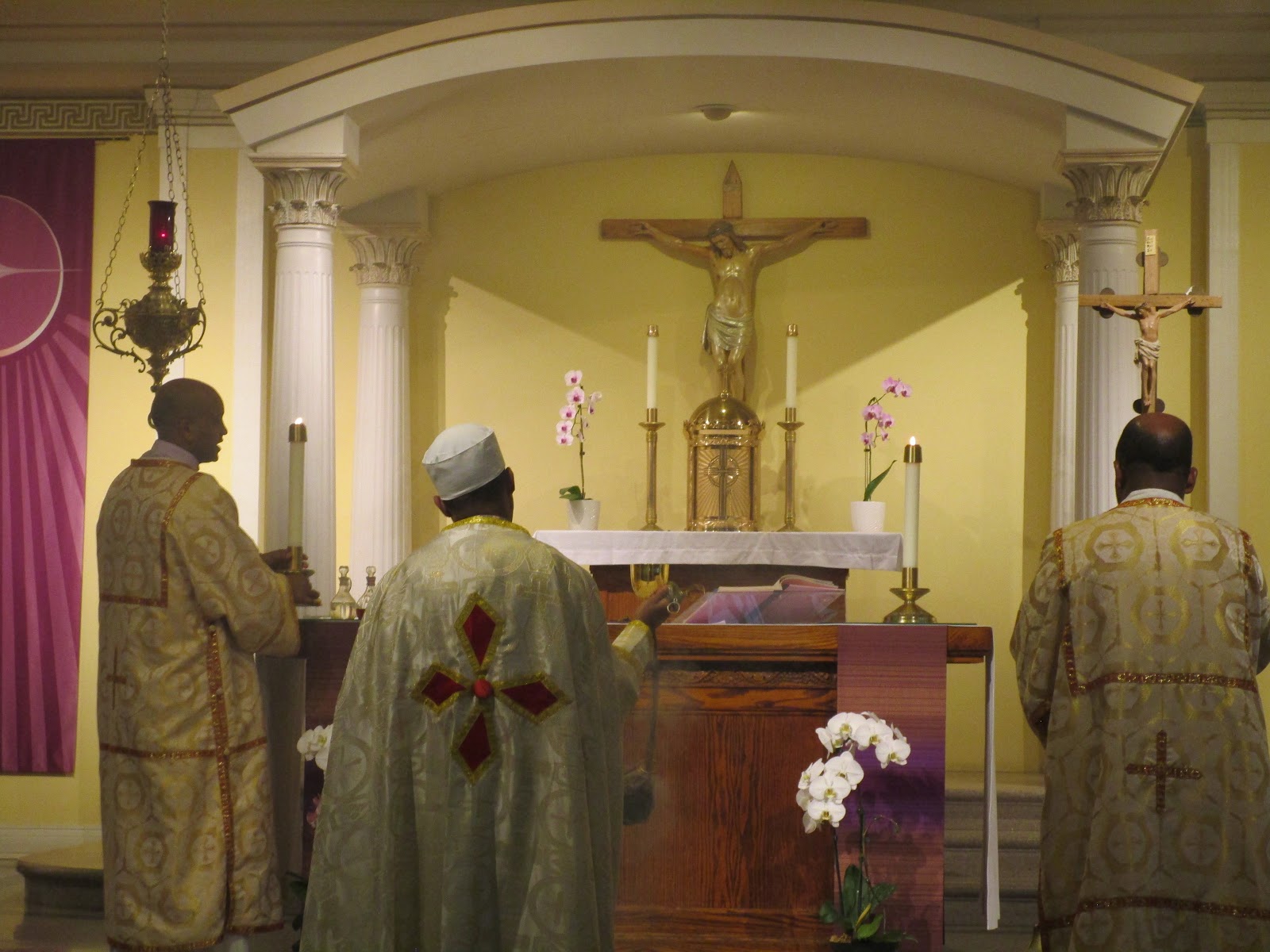
Divine Liturgy with the Holy Family Eritrean Catholic Community

The Truth About Christmas

'Tis the season once again! And with that, it's time for all the old canards about Christmas being a pagan holiday to come out of the woodwork. Catholics, Orthodox, and other mainline Protestant communities aren't attacked for celebrating Christmas only by militant atheists, but also by certain Fundamentalist Christians who see the celebration of Christmas as something "wicked". But of course, it's the militant atheists who are the loudest. There are plenty of snooty Scrooges who like to pretend to be intellectual. These "free thinkers" believe that Christmas is nothing but a rip off of various pagan holidays.

In this month's Christ Is Our Hope magazine, I explain why Christmas is so important to me as a Catholic Christian, as well as its origins in history. The story can be found here. Keep in mind, that for such a big topic, this is an extremely short essay. Pope Benedict XVI, however, had a very succinct statement on the issue from one of his books written while he was still a cardinal:
"The claim used to be made that December 25 developed… as a Christian response to the cult of the unconquered sun promoted by Roman emperors in the third century in their efforts to establish a new imperial religion. However, these old theories can no longer be sustained. The decisive factor was the connection of creation and Cross, of creation and Christ’s conception’ (The Spirit of the Liturgy, pp. 107-108)"
I've written more in depth about the subject here and here, and there are links within those posts that go much deeper.

Adoration of the Shepherds

Tuesday, December 5, 2017

New Article Catholic Stand

My latest essay is up over on Catholic Stand. It's the first in a short series of articles regarding the infallibility of certain teachings in the Church. The second part should be up within the next couple of weeks.  With this essay, I wanted to bring up something that has become more and more common among baptized Catholic Christians; that is, dissent from the teachings of Christ's Church. This can be on one point, or on several points. Often, such Catholics hope or expect that certain teachings will be redefined. But typically, they haven't undertaken a diligent search for the truth, and forget (or, perhaps ignore the fact) that several of these teachings they dislike and do not subscribe to are infallible in virtue of the authority Christ gave to His Church. You can see a snippet of the essay below:
Let’s look at one aspect of the Church’s teaching that is contested by many Catholics: the prohibition of contraception, particularly in Bl. Pope Paul VI’s encyclical Humanae Vitae (On the Regulation of Human Births). Many theologians and clergy immediately, openly dissented from Bl. Paul’s reaffirmation of the grave sinfulness of artificial contraception. But since he had not defined this teaching ex cathedra, some dissented by asserting that the pronouncement was not infallible, and therefore this teaching could be ignored in good conscience. This notion couldn’t be further from the truth.
You can read the entire essay here at Catholic Stand.

The Mass- José Benlliure y Gil

Monday, December 4, 2017

On Parishes Becoming "Sacrament Factories"

There's a term I've heard bandied about in some Catholic circles. The term is "sacrament factory" or "Mass factory". It has a negative connotation, that's used by priests and laity alike, and it refers to something like this: people show up for Mass on Sunday, maybe holy days, and they might go to confession once in a while. They'll baptize and confirm their kids as well, if they have any. There is no other involvement in parish life. Priests who use this term say they feel like they're just used for the sacraments and all they do is pump them out. One gets the image of a cow who continually pumps out milk until they're dry.

We need to stop this to get people more active in the parish, they say. We need to copy what our Protestant brethren are doing, they point out, because they are drawing people in who are joyful and "on fire". Here's the problem I have with this phrase, though.

Saturday, December 2, 2017

Our Role in Bringing Christ to All Peoples: Does This Include Practitioners of Judaism?

I recently got into a conversation with some people regarding on how to successfully undertake inter-religious dialogue, specifically with Muslims and Jews. In the last 50 or so years, and especially in just the 21st century, there has been a lot of confusion on this topic. Some go to one extreme and say that there are several ways to salvation; or, that for the Jewish people, there is a path to salvation through their understanding of the covenant and another path for Christians. On the other end of the spectrum, some claim that no Jews can possibly be saved unless they explicitly convert to the Catholic Church and become visible members of that Church while they are arrive on Earth. Both positions are extreme and false, so thankfully, the Church holds the logical, moderate position as she typically does.

One person mentioned that when trying to undertake this dialogue, particularly with Jews, the best way to do so would be to find some common ground on which to begin some kind of discussion. One could perhaps begin by recognizing that Jesus was a Jew, and a practicing one at that, before He founded the Catholic Church.  Another way would be to recognize that both Judaism and Christianity use the Decalogue as a foundation for morality.  I thought that these were some great observations. You have to find common ground when entering a discussion, such as recognizing that Jesus Himself was Jewish, and we have to always speak with charity, as St. Peter exhorts us in his First Letter. But another person made a troubling comment that gave me pause: the Church no longer asks (or teaches) us to actively convert the Jews. Is this really true? Where exactly does the Church teach this? As you'll see in a moment, the Church does not teach such a notion.

Wednesday, November 29, 2017

It's Time To Stop Treating Abortion As a Religious Issue

Too often, we see people, either on the political right or left, make abortion out to be a religious issue. It's something I've grown tired of hearing about, that is, that "my faith informs me that abortion is wrong". Yea, it does. But so does reason. My Catholic faith informs me that rape is morally wrong. Indeed, the Catechism of the Catholic Church defines this heinous act as an "intrinsically evil act." Since this is a tenet of my religious faith, would it be wrong to "impose my morality" and hope that the state declares this action to be a criminal offense? 

Well, if we follow the logic of many politicians, and really, many people all over the Western world, it would be wrong since this is the argument they give to continue defending such legislation as Roe v. Wade. But of course, we all know that our reason also informs us that abortion and rape are intrinsically evil acts, and the victims of both crimes (because they are crimes against humanity whether or not they are recognized as such by law) should be protected under the law.I think a case study in this unfair punting of the issue of abortion to the realm of only religious belief would be the Vice Presidential debate last year between Senator Tim Kaine and Vice President Mike Pence. Both politicians decided to make abortion strictly a religious issue, and I remember the whole time, as I watched, I could only pound my head on the wall as Pence had horrible arguments to counter Kaine's horrible arguments. Kaine played the "personally pro-life but politically pro-choice card"; a position that is so contradictory that anyone who subscribes to it should be ashamed of themselves; especially Kaine who remarked in the debate that "I try to practice my religion in a very devout way and follow the teachings of my church in my own personal life. But I don’t believe in this nation, a First Amendment nation, where we don’t raise any religion over the other, and we allow people to worship as they please, that the doctrines of any one religion should be mandated for everyone."
Let the Little Children Come Unto Jesus- Carl Bloch

Tuesday, November 28, 2017

What's At Stake With Heterodox Interpretations of Church Documents and Teaching

It's truly sad to see the confusion in the Church rising more and more. It comes from various places, from Cardinals calling Martin Luther a "common Church Father" with Lutherans, to theologians contradicting constant Church teaching by saying that capital punishment is always and everywhere intrinsically evil. But today I want to focus on something that has been generating controversy for quite some time now: heterodox interpretations of Amoris Laetitia, promulgated by Pope Francis in the spring of 2016. As many have written about this before, bishops are contradicting bishops, priests are contradicting priests, and what is considered grave matter for mortal sin in one diocese is not grave matter in another diocese. 

It's important to make a distinction that there are those that support an orthodox interpretation of AL, and there are those that support a heterodox interpretation. Those that support a heterodox interpretation of the papal document accuse those that hold to the "traditional"(that is, timeless) and orthodox interpretation of Catholic doctrine present in the document are "enemies" of Pope Francis. This couldn't be further from the truth. The bishops, priests, and laymen who have spoken out against heterodox interpretations of the document overwhelmingly love His Holiness and respect him and his office. That's why it's sad to see yet another priest throw his hat into the ring with heterodox interpretations of AL, accusing those such as Cardinal Burke or Archbishop Chaput of being "opponents" of the Pope, and further saying that such people are "dissenters, [who] assert that Christians who divorce from a valid marriage and remarry with adequate knowledge and consent enter the state of mortal sin. They insist that God gives the justified sufficient strength to bear whatever difficulties that may arise, that married couples can endure what comes their way if they take advantage of the grace offered to them."

These are the words of Fr. Gerald J. Bednar, Vice-Rector and Professor of Systematic Theology at Saint Mary Seminary in the Diocese of Cleveland. They come from a recent essay he penned in the English language weekly of L’Osservatore Romano, the daily newspaper of Vatican City. Several religious and laymen have commented on the troubling things related in this essay. Proponents of heterodox interpretations of AL might not want to admit it, and neither would it seem those who have not really looked into the ramifications of allowing reception of the Eucharist to the divorced and civilly remarried who live together more uxorio, but there are serious things at stake which are fundamental to the life of the Church: namely, the meaning of her Sacraments, what sin is, and what it means for doctrine to legitimately develop.
Apostle With Glasses