Thursday, May 31, 2018

Conversation on Iowa Abortion Bill

Earlier this month, Iowa Governor Kim Reynold signed into law "the heartbeat bill" which prohibits doctors from performing abortions after they've detected fetal heartbeats in pregnant women. This is a great step in removing the scourge of abortion in our country! Of course, the bill is being fought by many, but at the very least, it allowed for some conversation to be had on the subject.

On social media, one news organization asked readers whether or not the "heartbeat bill" was a good thing or not. Discussion on a friend's social media account ensued, and it's helpful to see at least a little headway made with the second of two people I dialogued with. My words will be in blue, one interlocutor's in red, the other in green, and other commenters in various colors.

Tom: Can’t get behind a bill that says what a woman can do with her body and decisions.

Nicholas: I wouldn't get behind a bill that says that either. What the bill proposes is the protection of the female's (or male's) body that lives in a mother's uterus from outside harm. As for "decisions", there are certain "decisions" that should not be protected by the law.
François Riss- Lullaby

Friday, May 11, 2018

Talking with Bishop Kurt Burnette on the Feast of Bl. Miriam Teresa Demjanovich

Over the past several years, I've gained another friend in heaven through a devotion to one of our country's newest saints, Bl. Miriam Teresa Demjanovich. I've written about her before on here, and when I had a chance to make this woman of God more widely known over at Ascension , I jumped at it. I was able to talk to a couple of Byzantine Rite Catholics, one a priest, and another the Bishop of the Eparchy of Passac in New Jersey. It was great talking to these two priests regarding this thoroughly American saint.

Click the link here to read the article in full, and see a snippet below:
Bishop Kurt Burnette, the current bishop of the Eparchy of Passaic where Teresa lived and died, sees her as a treasure not only to Byzantine Catholics, but to all American Catholics: 
“Her learning of the faith through the Byzantine Rite, really affected her theological outlook. She saw contemplation as an outreach of the Trinity…

Monday, April 30, 2018

Attempting to Explain the Problem of Evil in Our World

One of the most difficult things to explain to people today is why evil is permitted in our world. Even harder to explain is how this evil is permitted despite a loving God existing. Recently, I read the heartbreaking comments of a first responder, whose faith has clearly been shaken, and I can't say that I blame him. But he was honestly trying to understand how such horrible things can happen. His comments:
Ok, I am a paramedic. I tried to save a 2 week old beaten to death by his father. I understand that what happens are consequences of your decisions, but what did that baby do? How does that fall into the whole loving god? Or the children born with major medical issues? The ones that can never leave the hospital, whose entire lives are spent laying in bed breathing and eating through tubes?
These are honest questions, and he can't be faulted for asking them. I tried to give the best response I could to this, as I think it's a question that plagues the minds of many people today, both Christian and non-Christian.
Christ and the Samaritan woman at the well- Angelica Kauffman

Monday, March 19, 2018

Errors of the New Age Movement

The good folks at Ascension Press recently posted an essay I wrote regarding the errors of the New Age movement, and how its erroneous thinking has crept into many sectors of life in our culture. I include links to various statements of the Church in this overview. Click the link here to read the full story. A preview is below.
The flowery words of many New Age authors sound appealing, uplifting and inspiring, but when we get down to basics we see that such ideas as “being one with the universe” lead to a rejection of God. By turning inwards, people who become enamored with this philosophy attempt to experience various states of “consciousness” where they come to fuse with “the Whole” where “one is all and all is one”. 
This is in stark contrast to what we as Christians believe will happen to us once we enter eternal beatitude with God. We don’t become but a drop of water that coalesces into a giant pool, but instead we retain our identity as we become perfected sons and daughters of God himself in heaven. In reality, such attempts to become one with “the universe” is nothing more than a revisiting of Gnosticism, condemned by the Church very early on.
Triumph of Christ the King

Wednesday, March 7, 2018

Article on 2018 FOCUS Conference

Over the past couple months, I had posted some interviews with people I had met at the FOCUS SLS 2018 Conference in Chicago. Recently published in Christ Is Our Hope Magazine was my overview of the entire event. Again, this conference was awesome, and I only wish I had had the opportunity to attend something like this when I was in college.

In any case, you can read the digital copy of the magazine here, which includes a slightly edited version of my original essay, or you can read the full version of my essay below.

Jim Caviezel at the FOCUS 2018 Conference

Monday, February 26, 2018

Regarding Cardinal Sarah's Comments on Holy Communion in the Hand

A few days ago, Cardinal Robert Sarah, the Prefect of the Congregation for Divine Worship and the Discipline of the Sacraments, authored a preface to a new book by an Italian priest, Fr. Federico Bortoli, entitled "The Distribution of Communion on the Hand: Historical, Juridical and Pastoral Profiles". The full preface can be found here, and one can only hope the book will be translated into English at some point soon. In any case, Cardinal Sarah makes many good points throughout, quoting many saints and popes in the short preface. He points out the following:
Why do we insist on receiving Communion standing and on the hand? Why this attitude of lack of submission to the signs of God? May no priest dare to impose his authority in this matter by refusing or mistreating those who wish to receive Communion kneeling and on the tongue. Let us come as children and humbly receive the Body of Christ on our knees and on our tongue. The saints give us the example. They are the models to be imitated that God offers us! 
But how could the practice of receiving the Eucharist on the hand become so common? The answer is given to us — and is supported by never-before-published documentation that is extraordinary in its quality and volume — by Don Bortoli. It was a process that was anything but clear, a transition from what the instruction Memoriale Domini granted, to what is such a widespread practice today (...) Unfortunately, as with the Latin language, so also with a liturgical reform that should have been homogeneous with the previous rites, a special concession has become the picklock to force and empty the safe of the Church’s liturgical treasures. The Lord leads the just along ‘straight paths’ (cf. Wis. 10:10), not by subterfuge. Therefore, in addition to the theological motivations shown above, also the way in which the practice of Communion on the hand has spread appears to have been imposed not according to the ways of God.
Holy Communion of Mary Magdalene- Bernardino Campi

Monday, January 29, 2018

Dialogue With a Pro-Choice Bodily Autonomist

I feel myself forced to agree with something many people (at least in the Catholic world) have observed: dialogue is dead. or at least, it's nearly dead. If one isn't devolving into personal attacks, then they're going in a hundred different directions, or ignoring legitimate questions in the course of a discussion. Below is a prime example of such a "dialogue".

Rare is the person who can be intellectually honest and actually have a legitimate conversation. It has happened before, in my experience... but man alive, is it rare. What you will read below stems from a meme that was posted on social media. The pro-choice person went on many different tangents, so I'll only include relevant portions of the thread. His words will be in red, mine in blue, and other persons' in varying colors. As you'll see as you're reading, I post this (and kept engaging this person) because some people may have encountered his arguments in the past and not known what to say. As this Facebook page gets a lot of traffic, I at least wanted to reply for their benefit, if not my interlocutor's, so as to show how ridiculous his position is. That fact will become increasingly clear as the conversation progresses.

The meme in question
Tom: I didn't realize you were being forced to have abortions.

Harriet: Each baby is forced to die without a choice in the matter.

Tom: "Baby"? I thought we were talking about fetuses. Do people abort babies now?

Harry: Oops, Tom has apparently swallowed the lie that fetuses aren't also babies.

Friday, January 26, 2018

What Is Theosis?

When I was writing a previous article for Ascension Press, I was thinking about how to counter the narrative that we see running through many "New Age-y" (yes, I added a "y" there) circles. That is, one is all and all is one. We are, and everything around us, in some way, is God. It's basically pantheism in a modern veneer. Well, as always, the Catholic Church and 2,000+ years of tradition has a better answer for us on how the universe works. I recently had the opportunity to write a little bit about what that tradition entails in my latest essay over on Ascension's blog.

Below, you'll find a snippet of the article. I was able to feature quite a few selections from the Catechism as well... that is, the Catechism of the Ukrainian-Greek Catholic Church. The Byzantine tradition of the Church has a lot of insight on what "theosis" or "divinization" is all about, and it's definitely not about what our New Age friends would have us believe:
The early Christians had a specific name for this process of becoming more like God. It was (and still is) called “theosis”. We sometimes see this rendered as “divinization” or “deification” in Western Christianity, but the three terms all describe the same thing. St. Athanasius puts it very succinctly: “God became man so that man might become God.” The Early Church Fathers found the roots of this concept of theosis in Sacred Scripture: 
“His divine power has granted to us all things that pertain to life and godliness, through the knowledge of him who called us to his own glory and excellence, by which he has granted to us his precious and very great promises, so that through them you may escape from the corruption that is in the world because of passion, and become partakers of the divine nature.” (2 Peter 1:3-4)
Follow the link to read the article in its entirety.
The Harrowing of Hell

Sunday, January 21, 2018

Changing the Teaching Proclaimed in Humane Vitae Will Have Grave Repercussions

This may be a bit late, but I really wanted to address something that is very disturbing and should certainly cause faithful Catholics to pray even harder for the clergy. A story broke just a couple days ago, found over at the National Catholic Register, that a priest who was recently appointed to the Pontifical Academy of Life, Fr. Maurizio Chiodi, gave a lecture last month at the Pontifical Gregorian University in Rome on Re-reading Humanae Vitae [HV] (1968) in light of Amoris Laetitia [AL] (2016). What's scary here is that Fr. Chiodi tries to prove that AL has opened the door for contraception to be permissible and morally licit in certain cases. In his lecture, he opines: 
"[I]n situations when natural methods are impossible or unfeasible, other forms of responsibility need to be found. There are circumstances — I refer to Amoris Laetitia, Chapter 8 — that precisely for the sake of responsibility, require contraception."
He is not referring to natural means of regulating births, but to artificial contraception as being "responsible" in a greater degree.. I find this to be really troubling, that this priest would so twist the words of Pope Francis.
Jacques Laumosnier- Wedding of Louis XIV of France

Tuesday, January 9, 2018

Interview With Chaldean Catholic Pastor

I recently had the privilege to interview, and worship with, Fr. Fawaz Kako. He's a priest of a Chaldean Catholic parish here in the Chicago suburbs. As a native of Iraq, he has experienced first hand how Christians have been treated in the Middle East. To learn more about our Chaldean Catholic brothers and sisters, how they worship, and what they have endured, check out my interview with him over at Catholic World Report. You can find a preview of the article below:
"To be honest with you, the problem is not only with ISIS. The problem is that there is a systematic persecution against Christians. Not only Christians, but anyone who is different, or if, to be honest with you, if you are not Muslim. You are always looked at as a second-class citizen.  So the problem is not only with ISIS. For example, my name, Fawaz, is not a Christian name. It is an Arabic name. According to the law in Iraq, my parents were not allowed to give me a Christian name. I was given one at baptism, but my legal name has always been Fawaz. To give someone a Christian name was illegal."
The full interview can be found here.
St. Joseph Chaldean Catholic Church in Troy, MI

Sunday, December 31, 2017

Some Passing Thoughts on A Couple of Essays

About a month ago, Pope Francis' letter to the Argentine bishops on the implementation of Amoris laetitia (AL) in regards to the civilly divorced and remarried was published in the Acta Apostolicae Sedis. Dr. Edward Peters, a canon lawyer, addressed this with some clarifying remarks from Fr. Z over at his blog. I had posted some thoughts over there, and so as not to lose them in the shuffle, I'll post them here as well. I mainly wanted to bring up an excellent essay that had been published in print by Fr. Brian Harrison, O.S. A couple quick points though before I post those thoughts in response to Dr. Peter's essay...

I'm getting really tired of all the bad mouthing of His Holiness in certain pockets of the interwebs. It's really disgusting to see how he is being talked about in some quarters. Until proven otherwise, I take Pope Francis' words at face value: "I am a son of the Church". As I am too, I believe that there are many people out there who are twisting the pope's words in AL, and now in this published letter. After studying the issue I agree with both Dr. Peters and Fr. Raymond J. de Souza that "it is possible to read the Buenos Aires guidelines as consistent with the Church’s traditional teaching..." I defer to these men who are experts on the situation. I simply add my thoughts to this just to bring attention to what Fr. Brian Harrison had to say. My comment follows after the jump. It'd be best to read Fr.Z's comments linked above first before continuing.
The Country Wedding- John Lewis Krimmel

Thursday, December 28, 2017

Reply on Pope Pius XI's Magisterium

In my latest essay over on Catholic Stand, I finished up talking about how the infallibility of the ordinary Magisterium works; what it is and what it is not. There was one commenter who had a question about Pope Pius XI and his encyclical Casti Connubii. The commenter's words will be in red, with my reply in blue.

Tom: Yet the other part of Casti Connubii -- condemning equal rights for women -- is that still the Magisterium?

Nicholas: I'm afraid you'll have to be more specific. I'll be happy to engage more fully then. It seems different people have different meanings of "equal rights". There are many different connotations. I can assure you, that in the fullest sense of the term, Pope Pius XI did not condemn equal rights in this encyclical; quite the contrary, actually.

Also, keep in mind that there are three categories when declarations of the authentic Magisterium are made. Only those in the first two categories are recognized as infallibly taught.

Tom: Pius condemns those who say "the rights of husband and wife are equal" (para. 74), called "the subjection of wife to husband" an eternal truth though the specifics vary with time and place (para. 26 - 28), and "there must be a certain inequality" legally (para. 76). I think we can confidently say that these teachings have been superseded.

He also condemns mixed marriages without a special dispensation (para. 82), another teaching which has been superseded.
Pope Pius XI

New Article on Mary, the Mother of God

Christmas ain't over yet folks! Far from it! We celebrated St. Stephen the Protomartyr's feast yesterday, and we have another extremely important solemnity coming up next week: Mary, the Mother of God. I recently wrote an essay over at the Ascension Press Blog.

You can follow the link here to read the short article.


Wednesday, December 27, 2017

Reflecting on the Meaning of Christmas

Christmas is finally upon us! Glory to Jesus Christ! And of course, that means we still have several days of Christmas left, although many of our friends and neighbors unfortunately believe that it ended yesterday. Honestly, you could probably even argue that the Christmas celebration ended before it started, on Christmas Eve this year. Why do I say that? Well, how did our churches look on December 24th, the 4th Sunday of Advent? It's not very often that Christmas lands on a Monday. If your answer is similar to mine, that church was not as full as most Sundays, then you'll see why I can say that the Christmas celebration ended before it even started. And it's really something we should collectively be ashamed of.
Fra Diamante- "The Nativity"


Wednesday, December 13, 2017

Can the Laity Exercise the Ordinary Magisterium of the Church?

In response to an article I recently wrote on the infallibility of the Church and the Magisterium, I got into a bit of a discussion with a reader. Unfortunately, Disqus, the commenting feature used on this website, does not like me. I don't know what does it, but something in my posts always get marked as spam. Because of this, I wasn't able to get certain points across to my interlocutor. That section will be bolded when I repost the conversation below.

Basically, his contention was that the teaching authority of the Church does not rest solely with the ordained hierarchy, but with all the baptized. His words will be in red, with mine in blue:

Tom: Vatican II, in Lumen Gentium 12, expanded the infallibility of the Ordinary Magisterium to include all of those who have the Spirit of truth: "The entire body of the faithful, anointed as they are by the Holy One, [cf. 1 Jn 2:20, 27] cannot err in matters of belief. They manifest this special property by means of the whole peoples' supernatural discernment in matters of faith when "from the Bishops down to the last of the lay faithful" [Cf. 1 Cor. 10: 17] they show universal agreement in matters of faith and morals. That discernment in matters of faith is aroused and sustained by the Spirit of truth."
Second Ecumenical Council- Vasily Surikov

Saturday, December 9, 2017

Getting Real About the Latest Mockery of the Nativity

So this is going to be short and to the point (shocking, I know). As it's gone viral in the last week or so, you've probably heard about the "gay nativity" featuring two St. Joseph's kneeling next to the infant Jesus. It's ridiculous for so many reasons, but it's clear that the secular world (and even Christians who support redefining marriage) are having  field day with this, with one same-sex attracted person commenting on Twitter that they are "beaming". Why though? Why does this bring joy to people? Others though, responding to Fr. James Martin's ineffective denouncement ("it's banal... [and] silly") of such a horrible and sacrilegious image, gave this opinion:
"What you’re missing here is, while the idea of Jesus having two fathers may seem silly to you straight people, to gay folks, it isn’t. It’s a powerful affirmation of their right to exist in religious space that has systematically excluded them. Don’t call it banal."
First off, it's much more than just a "silly" notion; it goes against all respectable sensibilities of the Christian, whether they are gay or straight. Here's the point I want to make to people who support this, and I'll use pop culture so it's crystal clear to secularists...You say that it's OK to depict Jesus having two fathers. You say "it's a powerful affirmation of their right to exist in religious space". It is not an affirmation; it shows that you either A) despise the Christian faith and wish to mock it and its adherents, or B) you are a Christian that does not understand the Incarnation or the basic tenets of the Christian faith; in other words, you have no idea what you're talking about. Jesus had a Father, our heavenly Father, and a foster father in St. Joseph. Call him a stepfather if you want, or a guardian. These are terms we use today, right? By displaying this imagery of a "gay nativity", you are implying that God the Father and St. Joseph are involved in a homosexual relationship and that Jesus' mother, Mary, has no role to play. This is straight up blasphemy; it's much more than just silly or banal. When anyone says that Jesus had "two dads", it's no different from saying that someone has a biological father who died or is far off for some reason also has a guardian in his step father or legally appointed guardian who happens to be male. Would it be fair to use such a child's situation as a platform to support (and make "powerful affirmation[s]" for) state sanctioned same-sex marriage? Of course not!
Adoration of the Shepherds- Lorenzo Sabbatini

Wednesday, December 6, 2017

Reflecting on the Traditions of the Universal Catholic Church

Last Sunday, I had the opportunity to visit an Eritrean Catholic community. I say community because there currently are no parishes belonging to the Eritrean Catholic Church in North America. The Eritrean Catholic community is very small in this country, and in this case, the local community meets once a month for Mass at a Latin Rite church. To get a brief overview of the newest sui iuris Church, take a look at my earlier essay here.

Also, I was able to participate in Vesperal Divine Liturgy for the Vigil of St. Nicholas at a Ruthenian Catholic parish just yesterday. With St. Nicholas of Myra being my patron saint and all, I did not want to miss this opportunity. Anyone familiar with this blog knows that I don't hide my love for the Eastern Catholic Churches, particularly the Byzantine Rite. But I have to say, both of these recent experiences were absolutely beautiful. And in reflecting on their beauty, their magnificent praise of our Lord, I started thinking about my own rite, the Latin Rite, and how banality has become the status quo. I found myself asking a question that I'm sure many before me have also asked: what happened?

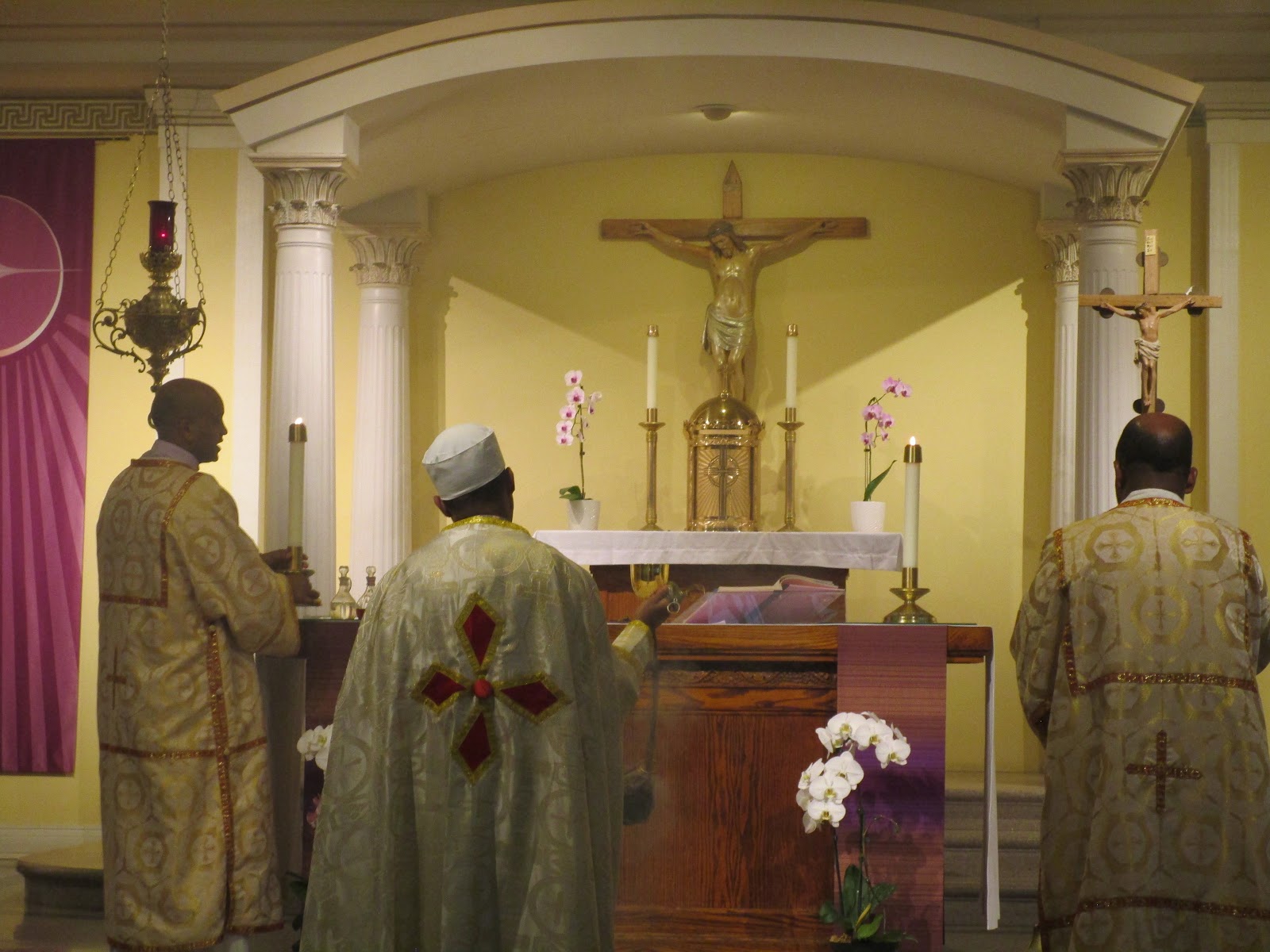
Now I won't give a full treatment here of my experience at the Eritrean Catholic Divine Liturgy, as I should have something up on that soon elsewhere, but I at least want to express how lovely my experience was there. As can be seen in the above picture, a lot of incense was used during the Divine Liturgy. A deacon and server assisted the priest, with the deacon constantly ringing bells at various points, such as when the Gospel was processed around the altar. This reminded me of the procession that the Byzantines do. The priest, while in the sanctuary, also blessed the four cardinal points with incense before reading the Gospel. The priest and deacon also came forward out of the sanctuary to read the Gospel, just like in the Byzantine Rite, although it was the priest that read and the deacon that held the lectionary. as the Divine Liturgy continued, I noticed that what was happening here, in the Alexandrian (or Ge'ez Rite) Divine Liturgy, was more similar to what the Byzantines do than what the Latins do. And both of those rites shared many similarities with what takes place in the East Syrian Rite, specifically the Syro-Malabar Catholic Church from what I remember.
Divine Liturgy with the Holy Family Eritrean Catholic Community

The Truth About Christmas

'Tis the season once again! And with that, it's time for all the old canards about Christmas being a pagan holiday to come out of the woodwork. Catholics, Orthodox, and other mainline Protestant communities aren't attacked for celebrating Christmas only by militant atheists, but also by certain Fundamentalist Christians who see the celebration of Christmas as something "wicked". But of course, it's the militant atheists who are the loudest. There are plenty of snooty Scrooges who like to pretend to be intellectual. These "free thinkers" believe that Christmas is nothing but a rip off of various pagan holidays.

In this month's Christ Is Our Hope magazine, I explain why Christmas is so important to me as a Catholic Christian, as well as its origins in history. The story can be found here. Keep in mind, that for such a big topic, this is an extremely short essay. Pope Benedict XVI, however, had a very succinct statement on the issue from one of his books written while he was still a cardinal:
"The claim used to be made that December 25 developed… as a Christian response to the cult of the unconquered sun promoted by Roman emperors in the third century in their efforts to establish a new imperial religion. However, these old theories can no longer be sustained. The decisive factor was the connection of creation and Cross, of creation and Christ’s conception’ (The Spirit of the Liturgy, pp. 107-108)"
I've written more in depth about the subject here and here, and there are links within those posts that go much deeper.

Adoration of the Shepherds

Tuesday, December 5, 2017

New Article Catholic Stand

My latest essay is up over on Catholic Stand. It's the first in a short series of articles regarding the infallibility of certain teachings in the Church. The second part should be up within the next couple of weeks.  With this essay, I wanted to bring up something that has become more and more common among baptized Catholic Christians; that is, dissent from the teachings of Christ's Church. This can be on one point, or on several points. Often, such Catholics hope or expect that certain teachings will be redefined. But typically, they haven't undertaken a diligent search for the truth, and forget (or, perhaps ignore the fact) that several of these teachings they dislike and do not subscribe to are infallible in virtue of the authority Christ gave to His Church. You can see a snippet of the essay below:
Let’s look at one aspect of the Church’s teaching that is contested by many Catholics: the prohibition of contraception, particularly in Bl. Pope Paul VI’s encyclical Humanae Vitae (On the Regulation of Human Births). Many theologians and clergy immediately, openly dissented from Bl. Paul’s reaffirmation of the grave sinfulness of artificial contraception. But since he had not defined this teaching ex cathedra, some dissented by asserting that the pronouncement was not infallible, and therefore this teaching could be ignored in good conscience. This notion couldn’t be further from the truth.
You can read the entire essay here at Catholic Stand.

The Mass- José Benlliure y Gil

Monday, December 4, 2017

On Parishes Becoming "Sacrament Factories"

There's a term I've heard bandied about in some Catholic circles. The term is "sacrament factory" or "Mass factory". It has a negative connotation, that's used by priests and laity alike, and it refers to something like this: people show up for Mass on Sunday, maybe holy days, and they might go to confession once in a while. They'll baptize and confirm their kids as well, if they have any. There is no other involvement in parish life. Priests who use this term say they feel like they're just used for the sacraments and all they do is pump them out. One gets the image of a cow who continually pumps out milk until they're dry.

We need to stop this to get people more active in the parish, they say. We need to copy what our Protestant brethren are doing, they point out, because they are drawing people in who are joyful and "on fire". Here's the problem I have with this phrase, though.