Showing posts with label Saints. Show all posts

Friday, May 11, 2018

Talking with Bishop Kurt Burnette on the Feast of Bl. Miriam Teresa Demjanovich

Over the past several years, I've gained another friend in heaven through a devotion to one of our country's newest saints, Bl. Miriam Teresa Demjanovich. I've written about her before on here, and when I had a chance to make this woman of God more widely known over at Ascension , I jumped at it. I was able to talk to a couple of Byzantine Rite Catholics, one a priest, and another the Bishop of the Eparchy of Passac in New Jersey. It was great talking to these two priests regarding this thoroughly American saint.

Click the link here to read the article in full, and see a snippet below:
Bishop Kurt Burnette, the current bishop of the Eparchy of Passaic where Teresa lived and died, sees her as a treasure not only to Byzantine Catholics, but to all American Catholics: 
“Her learning of the faith through the Byzantine Rite, really affected her theological outlook. She saw contemplation as an outreach of the Trinity…

Sunday, January 21, 2018

Changing the Teaching Proclaimed in Humane Vitae Will Have Grave Repercussions

This may be a bit late, but I really wanted to address something that is very disturbing and should certainly cause faithful Catholics to pray even harder for the clergy. A story broke just a couple days ago, found over at the National Catholic Register, that a priest who was recently appointed to the Pontifical Academy of Life, Fr. Maurizio Chiodi, gave a lecture last month at the Pontifical Gregorian University in Rome on Re-reading Humanae Vitae [HV] (1968) in light of Amoris Laetitia [AL] (2016). What's scary here is that Fr. Chiodi tries to prove that AL has opened the door for contraception to be permissible and morally licit in certain cases. In his lecture, he opines: 
"[I]n situations when natural methods are impossible or unfeasible, other forms of responsibility need to be found. There are circumstances — I refer to Amoris Laetitia, Chapter 8 — that precisely for the sake of responsibility, require contraception."
He is not referring to natural means of regulating births, but to artificial contraception as being "responsible" in a greater degree.. I find this to be really troubling, that this priest would so twist the words of Pope Francis.
Jacques Laumosnier- Wedding of Louis XIV of France

Thursday, December 28, 2017

New Article on Mary, the Mother of God

Christmas ain't over yet folks! Far from it! We celebrated St. Stephen the Protomartyr's feast yesterday, and we have another extremely important solemnity coming up next week: Mary, the Mother of God. I recently wrote an essay over at the Ascension Press Blog.

You can follow the link here to read the short article.


Tuesday, July 25, 2017

Reflections on the Readings for the Feast of St. Mary Magdalene

Yesterday, on July 22nd, the Catholic Church celebrated the feast day of St. Mary Magdalene, on of the feasts of the liturgical year that is celebrated on the same day in both forms of the Latin Rite and in the Byzantine Rite. I was lucky enough to attend Mass in the Extraordinary Form (EF) after receiving the Sacrament of Confession, and I just  briefly wanted to right down my thoughts after reflecting on the Scripture readings for the Mass in the EF, as well as the Scripture selection in the Liturgy of Hours' Office of Readings.

The First Reading in the Divine Office came from St. Paul's Letter to the Colossians 3:1-17. It was subtitled, "Your life is hidden with Christ in God". As I was reading this, waiting for Mass to start, a particular few verses close to the halfway mark caught my attention. It immediately called to mind the current state of affairs regarding the permissibility of certain sins that have become socially acceptable in the Western world, i.e., fornication, and homosexual activity in particular. Beginning from verse 5:
Put to death therefore what is earthly in you: immorality, impurity, passion, evil desire, and covetousness, which is idolatry. On account of these the wrath of God is coming. In these you once walked, when you lived in them. But now put them all away: anger, wrath, malice, slander, and foul talk from your mouth. Do not lie to one another, seeing that you have put off the old nature with its practices and have put on the new nature, which is being renewed in knowledge after the image of its creator.
Feast of Simon the Pharisee- Peter Paul Rubens

Tuesday, June 6, 2017

More From the Enlightened Mind of Blessed Miriam Teresa Demjanovich

I've written a few posts on here regarding Bl. Miriam Teresa Demjanovich, a young 20-something saint who was born, raised and died in New Jersey in the first few decades of the 20th century. An American saint through and through, and I've come to appreciate her even more after reading her biography, written by Sister Mary Zita Geis. I learned many new things about this valuable intercessor of ours, and my devotion to her has certainly grown as I try to figure out how I can attain at least some of the holiness that she exuded throughout her life.

First, I learned that she was certainly a mystic. While the visions she had aren't described in too much detail here, she did experience visions of our Lord and Lady, as well as an interesting encounter with St. Therese, the Little Flower. But most of her experiences seemed to be internal, and in the writings she sent to her spiritual director, he understood that she was definitely receiving spiritual consolations from our Lord such as ecstasies, raptures, visions and locutions.

She also mortified herself daily in many different ways, offering up even the smallest of sufferings to our Lord. For instance, she at times never touched the pew in front of her while kneeling during Mass and Eucharistic Adoration, and when rapt in front of the altar itself, she never let her feet touch the ground as she kneeled before the Blessed Sacrament.

Another interesting tidbit was that she was quite into sports. Particularly, that "boys' game" known as baseball! Of course, baseball is my favorite sport, and to know that she enjoyed playing America's pastime, as well as basketball, makes her same ever more closer despite her nearly unrivaled holiness and submission to God's will. She also took part in Spanish club, as well as drama club and glee club at high school, and performed in and wrote many plays during her high school and college days. Again, this is something still done by many of our high schoolers today. Yet through all these similarities with us Americans today, she was oh so very different. Her piety and desire to conform to God's will is truly an example to us all, and I can't wait to see her become canonized so that all of the United States will properly be able to venerate her as they do St. Elizabeth Ann Seton today.

So in the biography, I came across a couple of her spiritual conferences that were not included in her posthumous book, Greater Perfection. Remember, she wrote these secretly as the rest of he congregation thought that the convent's priest was writing them. Finding these felt like finding a long lost b-side from one of my favorite bands. I'd like to share one of those conferences here, as many of these are hard to find on the Internet, as it certainly moved me, and I hope it does the same for the reader here:

Sunday, April 30, 2017

When the Writings of Saints Are Deemed to be Politically Incorrect...

You may or may not have heard the story coming out of Orlando this past week concerning a catechist at a Catholic school who had passed out printouts of St. John Bosco’s 1853 essay “The Catholic Educated in his Faith.” The teacher was reprimanded, but to what extent is unclear. From the local article:
The Diocese of Orlando issued a statement about its decision to reprimand the teacher to the Huffington Post. Diocese officials said they would issue the same written statement to the Star-Banner, but that had not been received by press time.
The Diocese of Orlando officials would not answer questions to discuss details about the exact extent of the punishment.
Jacquelyn Flanigan, an associate superintendent with the Diocese of Orlando’s Catholic school system, said in a statement to the Huffington Post that she had spoken with Blessed Trinity’s Principal Jason Halstead and Smythe.
Flanigan stated that after speaking with the two men, the school district decided to “reprimand the teacher for this unfortunate exhibit of disrespect.” Flanigan also said in the statement that the material is also “not consistent with the teachings of the Catholic Church.”
It seems we've come to the point where even local dioceses are being too careful of upsetting the PC police. Here's a sampling of St. John's readings, and even I can admit that they aren't PC:
"We could say the Koran is a series of errors, the most enormous ones being against morality and the worship of the true God.  For example, it excuses from sin those who deny God out of fear of death;  it permits revenge; it guarantees its followers a Paradise filled only of earthly pleasures.  In short, this false prophet’s doctrine permits things so obscene, that the Christian soul is horrified just naming them."
But here's the thing... so what if his writings aren't PC? One could argue that Jesus Christ wasn't politically correct either, so to claim that St. John Bosco's writings go against Catholic teaching is simply mistaken. Let's see why that's so.
St. John Bosco and students

Monday, March 13, 2017

Timely Words From Pope St. John Paul II on Conscience

As part of my Lenten devotions, I'm currently reading "In Conversation With God" from Opus Dei priest Fr. Francis Fernandez. Today, meditation was "Conscience- the light  of the soul". He himself gives great insight, but he quoted the words of St. John Paul II; words that the great pope gave exactly 36 years ago this Wednesday from his Angelus address:

I provide the link from the Vatican website in Italian, and I was able to translate the relevant parts from the Spanish, with Google and Fr. Fernandez's translations. I thought this would be good to share this, as it regards to all the talk going on about "conscience" lately in the wake of the controversy caused by certain interpretations of Amoris Laetitia. Please read in its entirety, but here are some snippets:
St. John Paul II at Yankee Stadium, 1979

Sunday, July 10, 2016

Addendum and Clarification to Article on Muslims

In response to a piece I wrote a few days ago on an Episcopalian church allowing Muslims to worship inside the church building on a weekly basis, I received a letter from a commenter who felt I was being overly-critical, and had perhaps crossed a line in the way I had worded what they thought was an otherwise good article that made valid points. Below is the e-mail I sent back with some minor alterations, and I hope that if anybody else had similar questions regarding the piece, that this might clear it up. Obviously, I disagreed with the commenter for the most part, but realized I could've been a little more explanatory at some points. The commenter understood my reasoning after reading the reply you can find below, and hopefully it clears up any questions one might have had regarding it. I make it clear here why we must stand on guard for Truth, and help to lead as many souls as we can to Christ. I apologize if I was not clear enough before.
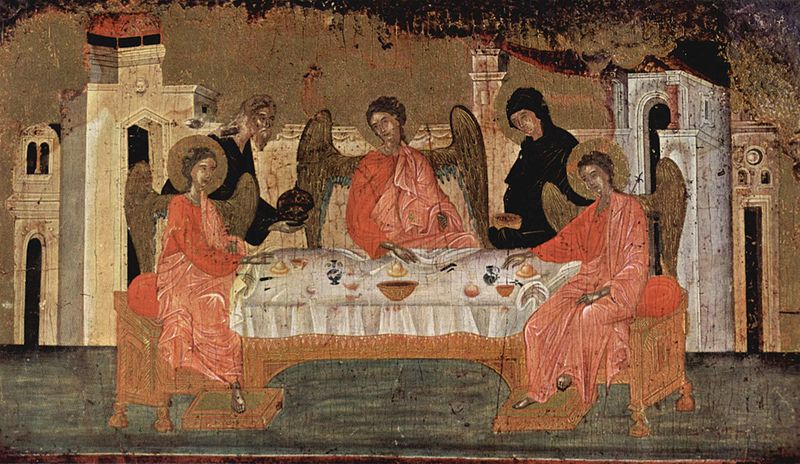
The Holy Trinity

Friday, March 11, 2016

Blessed Miriam Teresa Demjanovich on Sanctification During Spiritual Desolation

I finally finished reading Blessed Miriam's Greater Perfection recently, and I was constantly amazed at how engaging, timely and penetrating her writings are. All this from a young twenty-something nun from new Jersey. I don't know why I can't get over that. It must be because we are so close in age right now, and she was able to intelligently pick apart the worst parts of the human condition, and then peel them back to reveal the inherent goodness in each person. The inherent ability we all have to live for God's Will and His alone. The writing in particular I would like to share today may remind some of St. John of the Cross' Dark Night of the Soul. Basically, Blessed Miriam is telling us what we can do when we suffer that loneliness, that spiritual desolation when we think that Christ is far away, and is "asleep. Again, please visit the website of the Sisters of Charity of St. Elizabeth to learn more about this great intercessor in heaven and to purchase her writings across several different books. Her writing style and content is very thought provoking, to say the least. Here's a little bit from her spiritual conference on how to find sanctification in our lives even when we think we aren't necessarily feeling God's presence around us:
Blessed Miriam Teresa Demjanovich

Sunday, February 28, 2016

The "Nuptial Bath" of Baptism: A Not-So Novel Idea

I have to stop. I have to stop looking at secular news sites which have some of the most inane, ridiculous, and flat-out stupid "articles" I've ever laid my eyes on. On the bright side, sometimes perusing through these click-bait headlines moves me enough to write a response, hopefully helping to dispel the myths and misunderstandings the original story brings to the table. One such absurd article came from The Daily Beast with a title that tried too hard to make the author and website seem like they were cool, kind of like when your stereotypical hipster has to let you know that he got the hidden meaning to your favorite album long before you did. In "You're Doing Baptism All Wrong", the author, the controversial Candida Moss who is known for declaring the persecution of early Christian martyrs is a myth, tries to make the case that Christians everywhere have been confused on what baptism actually means for centuries, thanks to the "revelations" by a theology professor in his latest book. Essentially, it's being claimed that baptism wasn't always about death and rebirth, but implies baptism was only about a marriage to Christ. In addition, it's also claimed that Christ never instructed us how to baptize, nor described how to perform the sacrament. Which of course leads to the article's title. The wild claims and (not-so) subtle digs at Christian theology that Moss makes, while seemingly ignoring parts of what the theology professor actually said, will be thoroughly answered as we go bit by bit through this story. We will see that there are several different aspects to baptism in Catholic Christian tradition, and this has been seen throughout the Church from Apostolic times all the way to the present day, making it obvious that the whole nuptial bath meaning is not a novelty in the slightest.
Pope Sylvester Baptizes Constantine- Cristofro Roncalli

Saturday, February 13, 2016

More From Blessed Miriam Teresa Demjanovich on Making Good Friends

So as I've mentioned in previous posts, I've been reading the writings of Blessed Miriam Teresa Demjanovich. She was a young nun from New Jersey who lived in community with the Sisters of Charity of Saint Elizabeth. I came across a great selection not too long ago from her spiritual conferences found in her book Greater Perfection, which you can find for sale at the Sisters of Charity's website, which I especially wanted to share. It was another "Aha!" moment for me and really resonated with me as it pertained to a discussion I was having with someone, and hopefully, if the opportunity arises, I can share this selection with them. While talking about how to pray, she begins to muse a bit about how we should surround ourselves in the company of those that are virtuous; in the company of those that will lead us to (and those who have attained) heaven. I'd like to share this here, since these writings don't seem to be widely available on the web. If you get something out of the writings of this young saint, I highly recommend getting the book. It's an excellent read...
The Eternal Father- Francisco Bayeu y Subias

Wednesday, January 6, 2016

We're All Mothers, According to Blessed Isaac of Stella

A happy Epiphany/Theophany to all today! I had hoped to get a nice little post up about this great feast today, but that will have to wait until tomorrow. However, as I mentioned in my previous post, I added at the end how I recalled hearing somewhere that we are all called to be "mothers" to people. Well, I found the source of that thought I had, and it comes from a great saint who has had one of his homilies recorded in the Office of Readings in the last month: Blessed Isaac of Stella.

Blessed Isaac was a Cistercian who lived in the tenth century, and was a student of St. Augustine's neoplatonism. He has many surviving works, but I must say I'm partial to the selection from this particular sermon. I think this is something we should all reflect on, especially as we are still celebrating the Christmas season. Christ is now present to us, and we as the Church in turn should present Christ to others in our daily lives:
Although by nature he is the only- begotten, by grace he has joined many to himself and made them one with him. For to those who receive him he has given the power to become the sons of God. He became the Son of man and made many men sons of God, uniting them to himself by his love and power, so that they became as one. In themselves they are many by reason of their human descent, but in him they are one by divine rebirth.
The whole Christ and the unique Christ – the body and the head – are one: one because born of the same God in heaven, and of the same mother on earth. They are many sons, yet one son. Head and members are one son, yet, many sons. In the same way, Mary and the Church are one mother, yet more than one mother; one virgin, yet more than one virgin. Both are mothers, both are virgins.Each conceives of the same Spirit, without concupiscence. Each gives birth to a child of God the Father, without sin. Without any sin, Mary gave birth to Christ the head for the sake of his body.
By the forgiveness of every sin, the Church gave birth to the body, for the sake of its head.Each is Christ’s mother, but neither gives birth to the whole Christ without the cooperation of the other. In the inspired Scriptures, what is said in a universal sense of the virgin mother, the Church, is understood in an individual sense of the Virgin Mary. And what is said in a particular sense of the virgin mother Mary is rightly understood in a general sense of the virgin mother, the Church. When either is spoken of, the meaning can be understood of both, almost without qualification. In a way, every Christian is also believed to be a bride of God’s Word, a mother of Christ, his daughter and sister, at once virginal and fruitful.These words are used in a universal sense of the Church, in a special sense of Mary, in a particular sense of the individual Christian. They are used by God’s Wisdom in person, the Word of the Father.
This is why Scripture says: I will dwell in the inheritance of the Lord. The Lord’s inheritance is, in a general sense, the Church; in a special sense, Mary; in an individual sense, the Christian. Christ dwelt for nine months in the tabernacle of Mary’s womb. He dwells until the end of the ages in the tabernacle of the Church’s faith. He will dwell forever in the knowledge and love of each faithful soul.

Friday, January 1, 2016

Who's More "Blessed": The Theotokos or Those Who Hear the Word of God?

With 2016 finally off the ground, the Church today celebrates the Solemnity of Mary, the Mother of God. It's fitting that our first Holy Day of the year celebrates she who brought Christ into the world, setting the process of our salvation into action. But there's always been this one quote from the Gospels that I had a hard time understanding, and fortunately, it was clarified today at Mass by the priest in his homily. The passage I'm talking about is found in the Gospel of Luke:
...a woman in the crowd raised her voice and said to [Jesus], “Blessed is the womb that bore You and the breasts that nursed You!” But He said, “Blessed rather are those who hear the Word of God and obey it!” (Lk 11: 27-28)
In my mind, when I hear this read aloud, it almost seems like Christ is dismissing the importance of His mother. But of course, I know much better than that due to the various titles Mary has been given throughout the ages, and he special role as the most prominent intercessor for us before God. I knew I was probably missing something, and would often forget to delve into the matter more deeply, mainly because I knew it wasn't something to be worried about or taken in the context that many Protestants view it today. So what exactly is Christ saying then?

Icon of the Theotokos outside Hajdudorog, Hungary

Tuesday, December 29, 2015

The Profound and Beautiful Writings of Blessed Miriam Teresa Demjanovich

A little over two months ago, I learned of a great American saint who I have begun to have a devotion to. Her name is Blessed Miriam Teresa Demjanovich, and she lived in New Jersey for nearly all of her short life. I wrote a little bit about her and the book her Spiritual Conferences were compiled in, entitled Greater Perfection. I finally decided to purchase the book after seeing a local pastor talk about it and read from it during a homily one Sunday, and all I can say is... WOW.

OK, I can say a lot more than that obviously. However my jaw all but hit the floor when I read these writings that came from a mild-mannered, twenty-something nun in New Jersey. Someone who was just a few years younger than I at the time these conferences were written. I'm almost halfway through the book now, and I can't get over how relevant her writings are to today; how elegant and clear her manner of writing is. After reading a lot of apologetic and theological material lately, it's really nice to read something so edifying to spirituality. I have to say, she is definitely inspiring me to do more, and I sincerely hope that that inspiration stays alive in me for quite some time. Because she makes it clear that coming to "greater perfection" isn't for the weary. If you want to be challenged in your spiritual life, this is the book for you. It has an Imprimatur and a Nihil Obstat, and she begins writing about how one can become sanctified, gets into the efficacy of the Sacraments, and into the disposition of prayer and how to enter into a deeper state of meditation during prayer. I'm definitely excited to get into some of these later chapters; this makes me look forward to yet another three day weekend where I can get some reading time.
Blessed Miriam Teresa Demjanovich
As I haven't seen too many of her writings on the Web, I wanted to post the following selection from her conference on the Sacrament of Reconciliation.

Sunday, December 6, 2015

On This Feast of St. Nicholas...

While today may officially be the Second Sunday of Advent in the Latin Church, December 6th is the commemoration of the feast of St. Nicholas, Bishop of Myra. Obviously, as he is my patron saint, I love him and ask for his intercession before God every day, and the more I learn about him the more I love him. While there are many legends both old and new, there is plenty of historical backing to this great saint, and the evidence proves how holy of a man he was. My favorite story about him, where he punches Arius in the face during the Council of Nicaea is pretty dubious, but sources certainly put St. Nicholas there at the First Ecumenical Council of Nicaea where our current Creed was drafted.
St. Nicholas- Jacobo Robusti Tintoretto
A quick little history on this saint: St. Nicholas was born in the year 270 in the town of Patara, which is located in present day Turkey. His parents were very rich, but died when St. Nicholas was young. He was then adopted by his uncle, also named Nicholas, who was the bishop of Patara. He was a very humble man, and had a deep devotion to Christ, praying always. He also was very fond of the poor and those less fortunate, and often gave everything he could to help these people, especially poor children. This is where we see the tradition that Santa Claus gives gifts to children at Christmas.

St. Nicholas is one of only three men to have ever been nominated and made a bishop without being ordained a priest before his nomination. The other two are also saints, St. Ambrose and St. Severerus. Around the year 300, Nicholas was ordained a deacon, priest, then bishop all on the same day, and became the Bishop of the city of Myra, near where he was born.St. Ambrose, whose feast day of tomorrow, is another saint I am very fond of, and it's fitting that both of these great men were so full of the Holy Spirit, that the people were compelled to elect these holy men as bishops... before they had even received the sacrament of Holy Orders!

Anyways, I leave you all with this hilarious video made last Christmas by a secular Franciscan. It's a parody of "I Saw Mommy Kissing Santa Claus"... only Santa Claus isn't kissing, he's punching. And it's not your mom, but who else... Arius! St. Nicholas, pray for us!


Saturday, November 28, 2015

On Being "Old-School"

It’s an obvious fact of life that we Christians live in “the world”. That is, we live in the world as opposed to our true home, eternity in Heaven with God. And so as we live in the world, there are a myriad of different people, ideas and ideologies, cultures and moral codes. Or, as modern secularists (or even some ill-educated Christians, unfortunately) might put it, “there are many different ‘truths’ to be had.” We as Catholic Christians know better than that, of course. We know that truth cannot be subjective. By the very definition of the word “truth”, the act of calling any one truth subjective is a contradiction of epic proportions. A truth, especially THE Truth, is indeed objective. So if truth is objective, then the number of years, centuries, millennia, etc. that go by should have no bearing whatsoever on that truth. That makes sense right? So why is it that so often I constantly have to hear friends, co-workers and others tell me that such-and-such person is too “old school” in his thinking? That the bishops in the Catholic Church are behind the times? As if simply the passage of time itself is what determines if something is true or not? If I’m getting tired of it, then I know many of you are too.

What Is Truth? Christ Before Pilate- Nikolai Ge
Now of course, I’m not talking about every instance of the phrase “old school”. My favorite baseball and basketball teams sometimes wear old school, throwback jerseys. Or some video game or TV show I used to enjoy that makes a comeback in our nostalgic culture can employ a positive connotation for the old school saying. 

What I object to, and find grating, is how ideas such as chastity, temperance, sacrifice, prudence and the like can be dismissed out of hand by so many by negatively referring to these things as “old school”. As if by speaking those two words, the definitions and meaning behind those ideas and virtues become null and void, are not open for discussion, and are to be looked upon as archaic; as things that modern men and women would never dream of doing.

This happens to me often at work, where for instance I hear how a co-worker’s daughter is going out with a boy whose family is “old school” in that they don’t want the two cohabitating before marriage. Or when I was in high school, I had one of my good friends tell me that since I preferred to wait until marriage to have sex, I shouldn’t get my hopes up for finding a girl with similar values. They just don’t do that anymore, he said. “Anymore” implying that, perhaps, at one time people found it moral to abstain from sex before marriage, but such a thing just doesn’t happen anymore… that truth has changed!

Saturday, November 14, 2015

Outrage to Violence Should Be Global

It goes without saying a tragedy occurred in France yesterday. They certainly need our prayers as the hashtag making the rounds suggests. But if we're truly outraged, why are only focusing on what the main stream media presents to us? We should also be outraged at the suicide bombings that took place in Lebanon the day before, killing 41 and wounding over 200.

We should also be outraged at the Christians, Yazidis and other peoples that have been systematically massacred in countries like Syria, Iraq, Egypt and elsewhere. Massacres that have been occurring for months, years even, on end now.

Our Lady of the Assumption
Where is the outrage for these innocent people? Where is the option to "support" these peoples in a profile picture? Right now, Facebook has an option to turn your profile picture into the colors of the French flag, in "support" of the French people. It doesn't say to change your picture to "show that you support" France; but somehow they are implying that by simply changing your profile picture on a social media account, you are actually doing something to support the hundreds of people affected by this tragedy.


Sometimes I get the impression that it's simply "trendy" to stand in solidarity with victims or a cause on social media. If we have true outrage, I feel that we should make a big deal out of all these atrocities, and not just focus on one event. There is a bigger picture out there. Let's not only pray for Paris, but for the world at large. We need to pray, and work as well, to stop ISIS and other Islamist extremists so that all this carnage comes to an end. Every act of violence they commit is indeed outrageous.

The affected people of Lebanon, Syria, et. al are just as important as those in France. Their only fault in not being recognized is that they aren't a Western country. Luckily, in modern times, we can give temporal aid to our brothers with the click of a mouse. We can press our elected officials, who might have the power to physically do something, to bring about change. It's hard to do, and it's something I myself should do more, but to effect that change we should do so willingly. Christians should especially take that charge seriously. But I know many people that might have a difficulty in getting monetary aid to a hungry refugee or victim. This reminds me that St. James has a good point on the power of prayer, and how it may be our best bet for helping those affected by this terrorism:
The prayer of faith will save the sick, and the Lord will raise them up; and anyone who has committed sins will be forgiven. Therefore confess your sins to one another, and pray for one another, so that you may be healed. The prayer of the righteous is powerful and effective. Elijah was a human being like us, and he prayed fervently that it might not rain, and for three years and six months it did not rain on the earth. Then he prayed again, and the heaven gave rain and the earth yielded its harvest. (James 5: 15-18)
Our Lady of the Assumption and St. Barbara, pray for us!

Friday, October 30, 2015

Coming to "Greater Perfection"

Last weekend, I was able to attend Sunday Liturgy at the local Ruthenian Catholic Church. As they are of the Byzantine Rite, the Ruthenians are very, very similar to the Ukrainian-Greek Catholic Church. I love going to this parish when I can, and I consider myself lucky for living within 15 minutes of such a vibrant, reverent parish.

In the homily, the priest began by reminding everyone of how the previous week he had talked about the tour of St. Maria Goretti's relics had come through the state. He then told us the story of another young female saint, a Ruthenian Catholic saint who had just been beatified by Pope Francis on October 4, 2014. This was the first time I had ever heard of Blessed Miriam Teresa Demjanovich, and what a lovely example she has given us Catholics in the Church Militant.

Blessed Miriam Teresa Demjanovich

Blessed Miriam was born and raised in the United States, specifically New Jersey, so she remains one of the few American saints in the Church's history. While her life was short, as she died at the age of 26 from an infection, she produced many great writings and was an example of sanctity in the Sisters of Charity convent where she lived after graduating from college. In addition to her great writings, she also had mystical experiences in her life, one of those being a vision of the Blessed Virgin Mary while praying the Rosary.

The pastor mentioned in his homily that there was a priest by the name of Rev. Benedict Bradley, who often gave talks to the novices at the convent where Blessed Miriam lived every week. He wasn't that great of a writer, so Blessed Miriam would write the catechesis. He later said of her, " “I believed that she enjoyed extraordinary lights, and I knew that she was living an exemplary life…I thought that one day she would be ranked among the saints of God..." This fact wasn't revealed to the convent at large until after her death; and how surprised they were when they found out the erudite and wise words that came from the priest's mouth... were actually from the hand of a 20-something girl from Jersey! Just look at what she had to say on how we can all become saints:
“The saints did one thing: the will of God, but they did it with all their might. We have only to do the same thing; and according to the degree of intensity with which we labor shall our sanctification progress. We shall attain that height of glory in heaven that corresponds to the depths of humility we have sounded on earth. The harder you hit a ball on the ground, the higher it rebounds. The perfection of humility is the annihilation of our will — its absolute submission to the divine in every last detail.”
She really reminds me of St. Ignatius of Loyola, my confirmation saint. He saw what the saints did by reading about their lives, and he saw how they ended up; in heaven, that is. Blessed Miriam saw this too, and she speaks very eloquently on the subject. It's been a while since I've been very intrigued to read more on the life of a specific saint and their writings. Perhaps it's because Blessed Miriam is about the same age as me, and from these United States. Perhaps it's because of how she reminds me of St. Ignatius in how she encourages us to be saints by her witness. I'm hoping to read more about her soon, it seems like this would be a good place to start, a collection of the conferences she wrote for Rev. Bradley titled "Greater Perfection". I'm sure there are many more great insights on life such as this in her book:
 "Union with God, then, is the spiritual height God calls everyone to achieve – any one, not only religious but any one, who chooses, who wills to seek this pearl of great price, who specializes in the traffic of eternal good, who says 'yes' constantly to God…The imitation of Christ in the lives of saints is always possible and compatible with every state of life."

Her feast day is May 8th. Blessed Miriam Teresa, pray for us!

Sunday, October 18, 2015

Intra Arcana and Pope Clement VII: Did the Church "OK" Forced Conversions of Native Americans?

Recently, I posted a discussion I had regarding the canonization of St. Junipero Serra. During the conversation, the topic arose on how the Catholic Church has treated Native Americans dating back to the age of exploration. I had presented Sublimis Deus, a papal bull by Pope Paul III in which the Pope condemned harsh treatment of Native Americans, giving the Native Americans the dignity they deserved as human persons. To quote Paul III, Native Americans were “by no means to be deprived of their liberty or the possession of their property, even though they be outside the faith of Jesus Christ; and that they may and should, freely and legitimately, enjoy their liberty and the possession of their property; nor should they be in any way enslaved.” Later in the discussion, the person I was talking with presented me with another, earlier papal bull entitled Intra Arcana written by Pope Clement VII five years before Paul III’s pontificate began in 1534. I was given a quote from this document (and we will see in this essay, that it is the only quote from this bull that had been translated into English) that said the following:
“We trust that, as long as you are on earth, you will compel and with all zeal cause the barbarian nations to come to the knowledge of God, the maker and founder of all things, not only by edicts and admonitions, but also by force and arms, if needful, in order that their souls may partake of the heavenly kingdom.”
Needless to say, this sounds very harsh; indeed, it seems on the surface that the Pope is giving the “OK” on using force to convert and bring the Native Americans to God. This was the first time I had ever heard of Intra Arcana. How are we as Catholic Christians to respond to the charge that, right here, is proof that the Church believes it’s permissible to forcefully convert people? How does one respond to the claim that Paul III contradicts his predecessor Clement VII?  The answer is multi-faceted. Once we determine how much authority the Pope was pronouncing, explore the context of the document, understand what the content of the papal bull in its entirety contains (instead of just one quote), and delve into what the Church truly teaches on religious freedom, it will become apparent that the Church’s teaching on how to bring people to the knowledge of God, and how to bring them into His Church, has remained consistent and maintained respect of a person’s free will for two millennia.


Pope Clement VII


Friday, October 9, 2015

On the Canonization of St. Junipero Serra

There were many things in the news last month when Pope Francis visited Cuba and America for the first time, and it was pretty tiresome keeping up with all the stories across secular and Catholic media alike. One story that was of interest was the canonization of the founder of several missions in North America, Junipero Serra. This marked the first time that an American saint would be canonized on American soil. However, there was some controversy surrounding Serra's canonization. Many people were asking the Pope not to go through with it, on account of Serra supposedly being responsible for the deaths of many Native Americans. There was an article that was making the rounds across social media, found HERE, detailing the reasons why Pope Francis should not move forward with the canonization. 

I was able to engage in a discussion with someone via Facebook regarding the subject. A good exchange ensued, which is posted below, as I argued in favor of Serra's conversation. Reading the article above, and the article my opponent posts in his first comment will help frame our discussion and put what we're saying into contexts. Another note, as you'll see towards the end of the discussion, a little known papal document by Pope Clement VII is mentioned regarding the conversion of the Native Americans. Look for a post on this subject to be up on the blog in the very near future, going into much more detail than I do here. As for the discussion, my words will be in blue, and the other person's in red:

Well, the author of this article had at least one thing right in his diatribe: Pope Francis is assuredly not the "radical pope" that the popular media would have us believe, as the Pope himself has stated he is "a son of the Church."

The title of the article itself is misleading, implying that Junipero Serra actually murdered and enslaved Native Americans, effectively putting him on the same level of the bloodthirsty conquistadors, or other Native Americans such as the Aztecs who massacred and enslaved neighboring tribes as part of their tributary empire before the visitors of the New World arrived on their shores. The author also seems to be ignorant of what the purpose of the missions were, as well as of when and how the population of the indigenous peoples plummeted.

On the contrary, the missions were established to protect the indigenous people of California from enslavement by conquistadors, Spanish soldiers, and ranchers who would dominate and oppress them. The goal of the missions were twofold: to convert the Native Americans to the Catholic faith and protect them from the groups I listed above. Also, many of the indigenous peoples, such as the Chumash, were mainly hunter-gatherers. The Franciscans that founded the missions alongside Serra taught these people to grow crops and raise livestock.

The missions came under control of the Mexican government, following the events of the Mexican War of Independence. The Native American population of California was somewhere around 225,000 before the colonists came. While the population was reduced a third during Spanish and Mexican rule (and that was due to primarily disease and not murder) it doesn’t even compare to what happened once America admitted California to the Union. Once the 21 missions that had been established were effectively in ruins, and the California gold rush happened, the remaining Native American population received a huge blow when 80% of them were killed in through 1870, leaving only 30,000 people left. The rub is that this wasn’t due mainly to disease has it had been under Spanish rule, but nearly half were murdered.

St. Junipero Serra